



In diesem ArtikelAntippen und direkt zum Abschnitt springen
Updated: November 19, 2026. This guide walks you through how to estimate the value of your Pokémon cards and the safe ways to sell them.
In short: The value of a Pokémon card depends mainly on four things: Rarity, Condition, edition, and Language. First check the set and card number, then the Condition, and finally compare actual sale prices rather than asking prices. For quick and secure sales, selling to a dealer is a good option; for individual cards of very high value, Grading and a private sale may get you more.
Step 1: Identify the card precisely
Before thinking about prices, you need to know exactly which card you have. The same Pokémon character often appears in dozens of versions, and the price difference can be enormous. You'll need this information:
- Set symbol at the bottom of the card, showing which expansion it comes from.
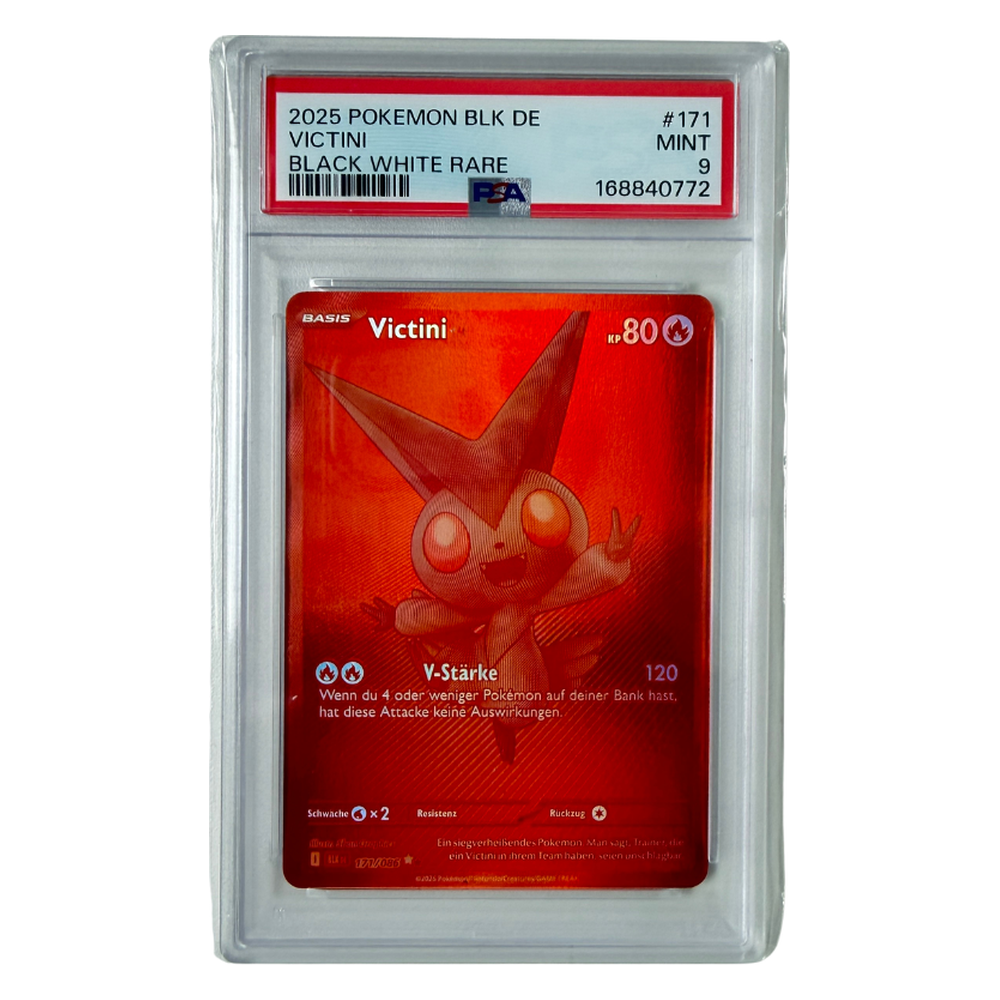
- Card number, for example, 171/086. If the first number is higher than the second, it's what's known as a Secret Rare outside the regular set list.
- Variant: regular, Holo, Reverse Holo, or Full Art.
- The card's Language.
- Special features such as a “1st Edition” stamp, Promo designation, or Prerelease stamp.
The manufacturer's official card galleries can help you identify the card. You can access them via the official Pokémon Trading Card Game website. For a faster option, use the card search on meinekartenverkaufen.de: enter the name or card number to see right away approximately how much we'll pay for the card.
Step 2: Identify the Rarity from the symbol
You can find the rarity symbol at the bottom of the card, and on modern cards at the bottom left next to the card number. According to The Pokémon Company, the following applies to current sets:
| Symbol | Rarity | Classification |
|---|---|---|
| black circle | Common (Common) | usually worth only a few cents |
| black diamond | Uncommon (Uncommon) | usually worth only a few cents |
| one black star | Rare (Rare) | usually low value individually |
| two black stars | Double Rare (Double Rare), e.g. many Pokémon ex | often low value, more for sought-after Pokémon |
| two silver stars | Ultra Rare, e.g. full-art cards | significantly more, depending on the card |
| one gold star | Illustration Rare | sought after for popular Pokémon |
| two gold stars | Special Illustration Rare | often the most valuable cards in a set |
| three gold stars | Hyper Rare (gold cards) | usually high value |
This classification is a rough guide. The actual Price depends heavily on which Pokémon is pictured and how popular the set is. A Charizard or Pikachu is usually worth more in the same Rarity than a lesser-known Pokémon. Older cards use different symbols and rarity levels. The guide Identifying old Pokémon cards shows you how to recognize them. You can find an overview of particularly sought-after cards in our Top 10 most valuable Pokémon cards.
Step 3: Honestly assess the Condition
The Condition often affects the Price more than anything else. Examine the card in good light, preferably with a lamp held at an angle. Check the corners, edges, surface (scratches, indentations, dents), and border centering.
| Condition | What this means |
|---|---|
| Mint / Near Mint | Like fresh from the Booster, at most tiny marks |
| Excellent | Light signs of wear, e.g. minimally whitened edges |
| Good | Noticeable marks on corners and edges, light scratches |
| Played | Heavily played, visible creases or wear |
| Poor / damaged | Creases, water damage, tears, usually only low value |
It's better to be a little stricter when assessing condition. Many sellers think their cards are in better shape than they really are, and this can lead to disappointment later when buying or selling. Find all the condition grades and an inspection checklist in our guide to assessing card condition.
Step 4: Consider edition, Language, and Grading
Edition
In the first sets from around 1999 to 2002, some cards have a “1st Edition” stamp (English “1st Edition”). Collectors are much more interested in this first edition than in the later unlimited edition. So always check old cards for such a stamp below the image on the left.
Language
English cards have the largest international market, while Japanese cards featuring certain illustrations are highly sought after. German cards often fetch slightly lower prices for modern sets. Learn more in our guide to Pokémon cards in Japanese, English, or German.
Grading
In Grading, a company such as PSA, BGS, or CGC evaluates a card's Condition and assigns it a grade, then seals it in a Sealed Case. A high grade can significantly increase the value of a sought-after card, while an average grade may do little. Grading costs money and often takes weeks, so it's usually only worthwhile for valuable cards in excellent Condition. Our article What are graded cards? explains exactly how it works. Find out whether Grading is worthwhile before selling in our guide Grading before selling.
 Victini #171/086 (Black Bolt) - PSA 9 MintView product →
 Mega Lucario ex #179/132 (Mega Evolution) - M3 Grading 9.5 Mint+View product →
 cardcosmos - 3" x 4" Premium Top Loader 35PT | 25 pcsView product →
 Ultra PRO Vintage ONE-TOUCH Magnetic Card Holder 35ptView product →
Step 5: Research realistic prices
Use prices at which cards were actually sold as a guide, not the highest listings on sales platforms. Many listings stay online for months at unrealistic prices. Also, compare only cards in the same Language, variant, and Condition. For very expensive cards, it's worth getting a second opinion, for example from a specialist dealer. The guide How to find the value of Pokémon cards explains which prices on Cardmarket really matter.
Note: A dealer pays less when buying than the eventual sale price. They have to inspect, store, and list the card, and bear the risk that it may remain unsold for a long time or that its Price may fall. This isn't a sign of a rip-off; it's standard with every reputable dealer purchase. For details on how a purchase price is calculated, see Understanding the purchase price.
Step 6: Choose the right selling method
| Selling method | Advantages | Disadvantages |
|---|---|---|
| Selling to a dealer | Fast and secure, also for entire collections | Lower than the eventual sale price |
| Online marketplace | Often the highest return for individual cards | Fees, shipping risk, effort, attempted scams |
| Classified ads | No or low fees | Negotiations, shipping and payment risks |
| Trading at events | Direct contact; cards can be inspected in person | more for trading than for money |
For a few very valuable cards, the effort of selling privately may be worthwhile. For larger collections, bulk cards, or if you want to sell quickly and without risk, selling to a dealer is usually the easier option. For a detailed comparison of selling options, see Where can I sell Pokémon Sell cards? and a worked example in Cardmarket, eBay or buyback?.
Sell cards to cardcosmos
We buy Pokémon cards, from individual cards and graded cards to entire collections and sealed products. Ideally, send us photos of the front and back or a list with the set, card number, Language and Condition. You can find all the details about the process on our We buy your cards page. For graded cards, there’s also this article: Graded Cards: buying and selling to cardcosmos.
You can offer your cards online directly on our buyback page at meinekartenverkaufen.de: search for a card or send photos, and you’ll usually receive a no-obligation preliminary offer within 24 hours. We have dedicated pages for the most common cases:
- Sell Pokémon bulk: €15 per 1,000 cards in German and English
- Sell your entire Collection: top cards individually, the rest as bulk
- Sell Graded Cards: PSA, BGS, CGC and more
- Buyback prices: all bulk prices at a glance
How to prepare your cards for sale
- Put valuable cards in a sleeve and a Toploader before shipping or bringing them in.
- Sort cards by set or value to save time when appraising them.
- Take photos of the front and back in daylight without flash.
- Don’t clean, polish, or press cards; this can lower their value.
Our guide Storing Trading cards explains which sleeves and Toploaders to use. Find out how to pack your cards safely for shipping in Packing and shipping cards.
Read more
- What are graded cards? Graded cards explained
- How to spot fake Pokémon cards: 8 signs
- Where can I Sell cards Pokémon?
- Sorting Pokémon bulk: Which cards to pull out
- Inherited Trading cards? Here’s what to do
Frequently asked questions
How can I find out how much my Pokémon card is worth?
Identify the set, card number, Language, and variant, assess the Condition honestly, and then compare actual sale prices for that exact version.
Which Pokémon cards are valuable?
Usually cards with a high Rarity, such as Special Product Illustration Rares or Hyper Rares, popular Pokémon such as Charizard or Pikachu, vintage 1st Edition cards, and cards in excellent Condition.
Is it worth getting my card graded?
Usually only for valuable, sought-after cards in excellent Condition. For inexpensive cards, the costs often exceed the potential added value.
Are cards without Holo worthless?
Individual common cards are usually worth very little. However, retailers often buy them in bulk, for example, we buy them for €15 per 1,000 cards. Non-Holo cards from vintage 1st Edition sets may also be in demand.
Does cardcosmos also buy entire collections?
Yes. You can find all the information about the process on our “We buy your cards” page. You can offer your Collection online directly on meinekartenverkaufen.de.




















Leave a comment
This site is protected by hCaptcha and the hCaptcha Privacy Policy and Terms of Service apply.